
Generac Power Systems
● Designed a functional elongated hexagonal perforated panel for an aesthetic look on the exteriors of the module
● Calculated the exhaust air thrust and performed FEA on different designed patterns on the exhaust manifold
● Designed a set of experiments to analyze the airflow simulation of 3d printed prototype on the exhaust
● Revamped the complete design of bracket assembly and simulated each component under varying load conditions
● Determined the fastener schedule for a different types of mounting surfaces and documented them
Generac Power Systems
● Designed a functional elongated hexagonal perforated panel for an aesthetic look on the exteriors of the module
● Calculated the exhaust air thrust and performed FEA on different designed patterns on the exhaust manifold
● Designed a set of experiments to analyze the airflow simulation of 3d printed prototype on the exhaust
● Revamped the complete design of bracket assembly and simulated each component under varying load conditions
● Determined the fastener schedule for a different types of mounting surfaces and documented them
Design and Optimization of Heat Pipes
• Designed heat pipes used in laptops by varying material, shape, heat flux, and fill ratio parameters in SolidWorks.
• Calculated the heat transfer for four models and determined the most efficient model with flow analysis in ANSYS.
• Machined the best model, tested the prototype in a real-time simulation set-up, and validated the efficiency.
Findings
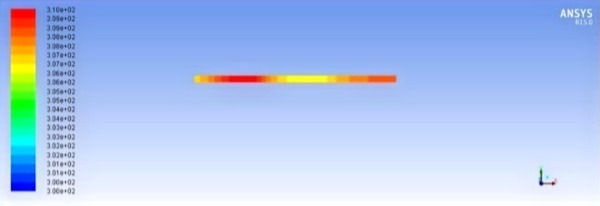
•Contours of Temperature depicting the temperature distribution across the length of the heat pipe
•A comparative study of cylindrical and flattened heat pipes having different screen mesh size wicks is conducted at various inclinations (90 to +90) for a heat load range of 10–60 W.
•The effect of flattening Heat pipes with the same screen mesh wick at various inclinations is analyzed.
•Thermal efficiency of a heat pipe decreases with increased heat input because every heat pipe has its capacity.

Solution Strategy
•A transient simulation (i.e., time-dependent simulation) with a time step of 0.0005 s is carried out to model the dynamic behavior of the two-phase flow and the pool boiling process.
•The time step has been selected based on the Courant number, which is the ratio of the time step to the time a fluid takes to move across a cell.
•In the current CFD model, the continuity equation has been solved to track the volume fraction of each phase, and the energy equation has been solved to observe the temperature distribution along the computational domain.
•Then, in the solution setup, create a plane surface in the fluid region and place it in the middle of the pipe in the surface, create contours then, select the temperature and select the variant, then see the results as follows.
Simulation Results


Experimentation

Test Results


